April 28th, 2025
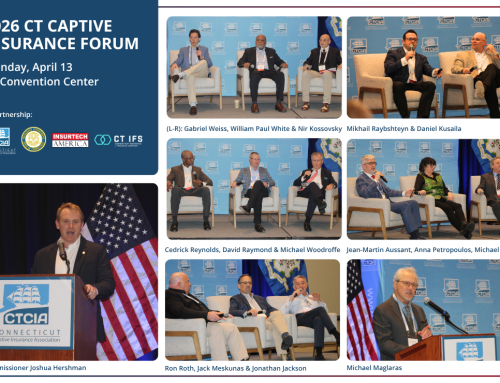
CTCIA collaborated with Insurtech Hartford and the Connecticut Insurance Department to host the 2025 CT Captive Forum on Monday, April 28th at the CT Convention Center in Hartford, CT.
Date: Monday, April 28, 2025
Time: 1:00pm – 7:00pm
Location: CT Convention Center
Key topics of discussion included:
- How Mainstream Runoff is Making its Way into Captives
- Adding Employee Benefits to Your Captive
- Captive Insurance Journey: What You Need to Consider in Direct and Indirect Tax
- Parametric Solutions and Technological Innovations: A Game Changer for Climate Resilient Insurance
- The Globalization of Risk: Captives on the Forefront of Change
- Connecticut’s Captive Domicile Responses to Increasing Challenges to Businesses
- Current issues with Insurance and MGAs/InsurTechs Employ Captives to Support Program Business
Agenda:
1:0-1:15 PM | Keynote Address

- Andrew Mais, Connecticut Insurance Commissioner
1:15-1:40 PM | Panel I: How Mainstream Runoff is Making Its Way into Captives
Over the past few years Captive strategists have become open to exploring the potential uses of run-off transactions for a broader number of cases that might historically not have been contemplated. Our panel will present a variety of types of captive issues that lend themselves to such a run-off opportunity. We will then select one for a deeper dive into the issues and mechanics that enable a captive dispose of its legacy business and free it up to achieve its goals in new and professionally exciting ways. For this we will consider a cross border transaction and demonstrate how the legacy run-off acquirer can enable seriously useful restructuring options that were not previously available to the Captive world.
Featuring:


- Anna Petropoulos, Founder & CEO, Apetrop USA Inc
- F. Hale Stewart, Captive Development Officer, Higginbotham
- John Bauer, Executive VP, RiverStone
1:40-2:05 PM | Panel II: Adding Benefits to Your Captive
Using a captive for employee benefits is becoming extremely common. Quantitative benefits (cost savings) are certainly one major driver. The qualitative benefits such as access to greater data and more control over plan designs and plan provisions are also becoming extremely important to employers. Employee benefit programs can potentially offer a captive third-party coverages and are usually considered to be uncorrelated risks. This improves the captives risk distribution framework and can allow organizations to gain additional efficiencies on their capital. The discussion will focus on domestic and international programs for Medical, Life, Disability and Voluntary Benefits.
Featuring:


- Prabal Lakhanpal, Management Consultant, Alera Group, Inc.
- Debbie Gaglioti, President CFO, Captive Planning Associates
2:40-3:05 | Panel III: What You Need to Consider in Direct and Indirect Tax
Tax considerations are pivotal at every stage of a captive insurance company’s journey, from establishment to closure. This seminar will provide an in-depth exploration of critical tax themes, including federal, state, and international income tax challenges, as well as key indirect taxes such as premium tax, self-procurement tax, IPT for non-U.S. entities, and FET. Attendees will also examine the implications of not qualifying as an insurance company for tax purposes. Join us for an interactive session with expert insights and a Q&A to address your specific questions.
Featuring:

- Daniel Kusaila, Tax Partner, Crowe
- Michael O’Mailey, Managing Director, Strategic Risk Solutions
3:05-3:30 PM | Panel IV: Parametric Solutions and Technological Innovations: A Game Changer for Climate Resilient Insurance
Parametric solutions, often integrated within captives, enable faster response times through predefined triggers and smart contracts. This accelerates payouts and aligns seamlessly with the agile nature of captives, allowing them to adapt far more effectively to emerging risk types. Traditional insurers often take two to three years to respond due to lengthy regulatory approval processes. Beyond expanding coverage, parametric solutions reduce loss investigation complexity and provide insureds with confidence in prompt payouts. They complement traditional insurance and other lines commonly written by captives. This session explores how this powerful corporate finance tool functions.
Featuring:


- (Moderator) Christina Kindstedt, President, Advantage Insurance Management USA
- Yani Wolf, CEO, Arx Veritas
- Dr. Marcus Schmalbach, CEO, RYSKEX Inc
3:30-3:55 PM | Panel V: The Globalization of Risk: Captives on the Forefront of Change
It’s nothing new that captives have been “agents of change” since the common use of captives in the 1950s. However, in a post-pandemic world, it’s clear that any captive formed, regardless of domicile, is going to be part of a new global network of risk assumption activity. Captive industry veteran Michael Maglaras will provide insight into how captives will be used to underwrite the risks associated with upheavals in the global supply chain, the domino effects of climate change, and the ability for captives to secure needed reinsurance coverages in the new global age of change and challenge.
Featuring:

- Michael Maglaras, CIC Principal Executive Officer, Michael Maglaras & Company
4:35-5:00 PM | Panel VI: Connecticut’s Captive Domicile Responses to Increasing Challenges to Businesses
Join us at the CT Captive Insurance Forum for an in-depth discussion on how Connecticut’s captive insurance domicile is evolving to address the increasing challenges businesses face in insurance availability and affordability.
Featuring:


- (Moderator) Mike Serricchio, Managing Director, Marsh Captive Solutions
- P.J. Cimini, President, Nutmeg State Financial Credit Union
- John Bordeaux, Trustee, Montessori School of Greater Hartford
- Jared Kosky, Deputy Commissioner, CT Insurance Department
5:00-5:25 PM | Panel VII: Current Issues with Insurance and MGAs/Insurtechs Employ Captives to Support Program Business
The P&C insurance industry is under the gun. In congressional hearings and state capitols, constituents are wondering if insurance, especially personal lines, will be available and affordable. Some are even asking if the future is “insurable.” In this panel Jerry addresses the concerns with a three-fold discussion on first-party insurance trends, developments in long-tailed insurance lines, and a look at public policy issues impacting insurance buyers, providers and the broader economy. The discussion will also touch on the unique factors at play in “problem child” states — Florida and California.
In addition, MGA’s and InsurTechs embody the use of the latest cutting-edge technologies to make insurance cheaper and easier to use. This makes for heightened customer satisfaction – but it does require constant capital investment to keep up to date for InsureTechs – and MGA’s can only negotiate so much for commissions!
Increasingly, MGA’s and InsurTech’s are turning to captive insurance to help deploy risk capital more effectively and increase overall profitability. In this session the panel will lift the curtain on how the strategic use of captives help MGA’s and InsurTechs keep ahead of their competition.
Featuring:


- (Moderator) Mark McDonnell, Senior Portfolio Manager, Aon
- Jerry Theodorou, Director, R Street Institute
- Michael Douglas, Director of Business Development, Aon
4:30-5:00 PM | Closing Remarks
Featuring:

- Fenhua Liu, Assistant Deputy Commissioner, Connecticut Insurance Department
5:00-7:00 PM | Networking Cocktail Reception